New Project - The Old D&D Shelf...

Once upon a time, a young man named Seth played D&D in middle school and high school. Seth still plays D&D, but it's this young man that ultimately claims the title of protagonist of this project. That kid, he collected random D&D stuff, but truly, truly, so random. The basics, of course. But, also, so many things that were specific to his liking, found in odd bookstores, scattered across a time from the late 80s to the late 90s. D&D didn't return to my brain until 2015, it's hold ending somewhere in early 2001. Playing D&D also meant playing Palladium's Rifts, Gamma World, and a few other games. This is the beginning of a currently running story I need to tell, some other time.
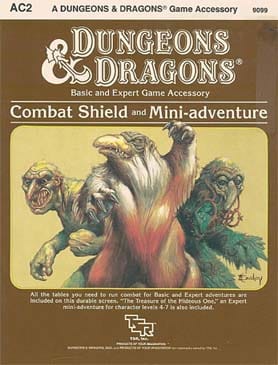
Today I pulled something off one of the "old" D&D shelves, and I want to write about that. This, even, could be a thing. I don't really know. But, let's just jump into it. There's a few shelves and scattered other publications not actually a part of the shelves-I-use to run games now. Dusting it off today, and I mean literally, I pulled 1984's Dungeons & Dragons AC2, Basic and Expert Game Accessory, Combat Shield and Mini-Adventure. I think what I pulled is just the Combat Shield. We'd call this a DM's Screen now. A lot less...combative. It's just a bunch of basic, rules-based info, that a DM needs for quick reference. What I want to do is document how this little 2 fold (six-sided) piece of D&D memorabilia inspires me. Capture the process, if you will.
7 classes exist, that's the clearest thing from the start. Fighter, Cleric, Thief, Dwarf, Elf, Halfling, Magic-User. For the way I run my D&D-adjacent games now, I hate this. 4 are so broad, while 3 are basically species. Still, there's something to take away. It's easy to get carried away with classes in thinking about what you want building a make-believe world. Ultimately though, adventurer's are a variation of warrior, religious figure, resourceful skill-jockey, magic using person, or inherently neat civilized species. I can't insist, at the moment, that I see characters in broader categories, to be honest. That'll also be another post.
Generally speaking, this isn't the kind of piece of D&D memorabilia that inspires. Charts and numbers do not build a world or a story, they help you determine outcomes. Two things really click for me right away, once I accept the boundaries of class/species above - there's a combat sequence table that includes something I use in my games, there's a way to look at one of the sections as a way to run ANY game and artificial period within it, and there's a lot of cool names for PC levels. I want to break these three things down into their own little sections.
Combat Sequence - Morale Check, Retreating, Surrendering, Other Special Results
There's so much to say about "Combat Sequence" of tabletop games, so let's just focus on this particular occurrence (an old D&D product) and how my current 5e/5e-adjacent D&D brain thinks about the sequence. There's a ton of other ways to approach this in other TTRPGs. I make a reference to one below just for posterity of the blog.
Morale Check
I use the concept of a Morale Check - limited here and in my own games - to monsters/NPCs only, and specifically for combats where the enemy shouldn't win. When I know the purpose of a combat is to drain resources and also let the PCs deal with people inherently arrogant about their expectations (or for other reasons), you want a chance to end it early, but realistically. This ultimately ends up being an INT, WIS, or CHA check in 5e. (What about Rifts/Nightbane?) Rarely is it at disadvantage, unless a low CR creature is also clearly in a chain of command that's collapsed or it's self-preservation makes it likely to run. A success mean it sticks to the fight. DCs don't vary as much as you think. 12 for the most basic of monsters starting to lose a fight, and up to 15 when there's someone commanding them, often based on the passive charisma of an NPC stat block. As in, the DC goes up because the chain of command collapsed.
Examples
Retreating, Surrendering, and other Special Results
Special Combat Results.
Most of these things occur because of special conditions you set in advance, like Gregor the Thief surrenders if more than 2 comrades die, or Butter the Barbarian retreats if Cookie Monster goes down, dragging her unconscious body. If your PCs are doing well in a combat, sometimes you want to present to them a scenario of "these evil NPCs, these monsters, they're smart enough to not want to die" and see what they do. Or, maybe you want to see just how much the party pursues those they consider evil-doers, if suddenly they're running with their backs turned.
Order of Events in a Game Turn
The title here is misleading. This old DM's Screen uses that title for something like a Hexcrawl or Dungeon Crawl scenario. Basically, it's a checklist for what they call a Game Turn, which is different in this old edition from Combat. It's an example of something that is regularly discussed in D&D circles - are their turns outside of combat? In this edition, quite clearly there is and it's actually a really good way to handle things in non-combat!
Checklist
Wandering Monsters Check
Actions by the Party - movement, listening, searching, mapping, whatever
Results
1 - if a new area is mapped, describe it. (hence, why this feels hexcrawl-like_)
2 - if an encounter occurs, move into encounter rules/combat rules for checking surprise, or various social interaction rolls, contested rolls if a conversation occurs.
3 - if something is discovered, describe it, then party takes actions, then results.
4 - if nothing happens between the check and the results of actions, this game turn ends.
Additional note here - this checklist makes me want to do a Hexcrawl type game, but still keep the heavy levels of roleplay and NPC use that I tend to lean into.
But, here's what is interesting. You CAN run any discrete amount of time using this checklist, anywhere in your game.
While I need to get a different article written about how I DM, this checklist is a great way to handle a sandbox-style campaign, or specific areas of a campaign, where players are moving around exploring, and you want to create periods of exploration, risks that might occur, and how they tackle those risks. Rather than a Wandering Monsters Check, it could be simply a "Does anything interesting happen or do they pass through a relatively safe and non-descript area? One way to use this to feel like you as the DM have some control over the action and response of the game is to divide up the time in whatever way feels right to you, and use this system to chart things out.
So the party leaves town and get on a road - you decide the journey is 3 segments of time, one of which is a specific NPC encounter. The other two, you want to add some randomness and realness to things, so you have a little random table of Monster options and general obstacles for the other two. You decide the first bit of journey is a half day all at once, moving from a city through its nearby farming villages. You do a check, and there's a merchant caravan broken down on the road, and they need some assistance. Work through it with your characters. Then the second segment is a pre-arranged NPC interaction, an important figure on the road that the party knows of. Your third segment, you're back to this checklist above, and you roll that a bunch of bandits decide to attack the party in a wilderness location.
Really nice way to deal with segments you design between important locations or between important story beats. When you know a bunch of time is going to pass while moving between locations, you can set up these checklists and use random tables to fill in and keep things interesting, or on story, or even develop side quests from the checklist. I call my important scenes that are happening because of party decisions "BEATS" and now use this checklist in between the beats, often with random tables I've written up in my free time.
PC Levels having "Titles" in 1984
Cleric - Excellent Variety
acolyte, adept, priest, vicar, curate, elder, bishop, lama, patriarch/matriarch
Wizard, contributes shit but Medium and Seer
conjurer is ok, but specific to a certain school these days, as well as enchanter and necromancer.
magician, mage, wizard kind of do all say the same thing though.
Elf - warrior seer, swordmaster conjurer, swashbuckler enchanter, myrmidon warlock, champion sorcerer, lord wizard
Many of these are best used elsewhere, and not for an elf anymore, but are still nice titles you can find a place for with a 5e PC.